Research

01

Where do binary black hole mergers come from?

Binary black-hole mergers offer a unique way to study the physics of massive stars and dense stellar environments at distances where these systems are otherwise difficult to observe. By measuring the masses, spins, and other properties of merging black holes, we can learn about the lives of their stellar progenitors and the environments in which the binaries formed.

A major focus of my research is understanding the origin of the excess of binary black-hole mergers near 35 solar masses and using this feature to connect gravitational-wave observations with the physics of massive stars, binary evolution, and dense stellar clusters.
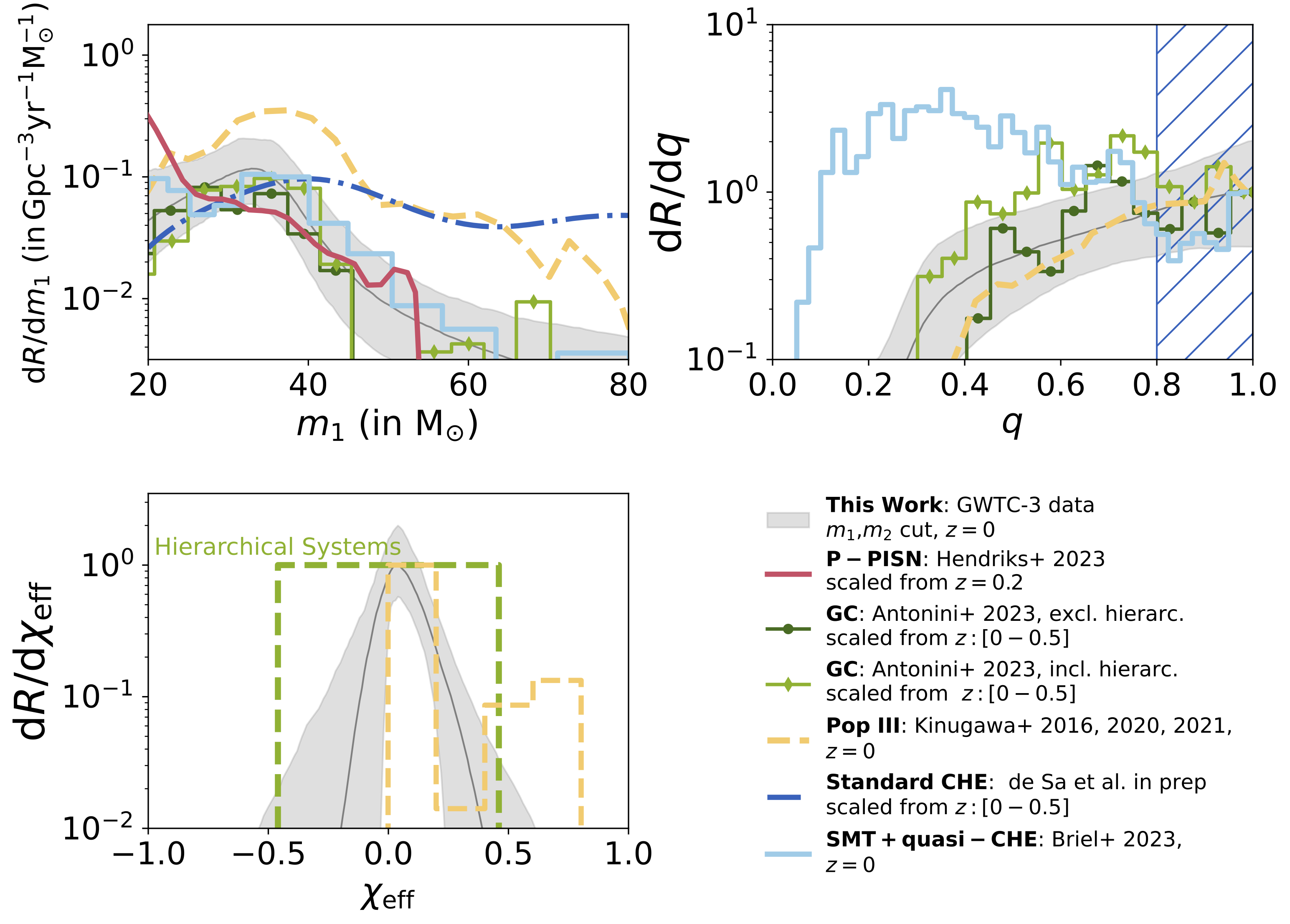
Comparison between binary black-hole mergers near 35 solar masses and predictions from different formation channels
Comparison of the observed binary black-hole population near 35 solar masses with predictions from several formation channels. From Roy, van Son, and Farr, A Mid-Thirties Crisis: Dissecting the Properties of Gravitational Wave Sources Near the 35 Solar Mass Peak, Classical and Quantum Gravity 42, 225008 (2025) .

02

How fast is our Universe expanding?

Gravitational waves offer a new way to measure the expansion history of the Universe. They allow us to determine luminosity distances independently of the cosmic distance ladder, but they do not directly provide redshifts. We can measure redshift when an electromagnetic counterpart identifies the source, but such coincident detections are rare. Alternatively, we can use the fact that gravitational-wave detectors measure the redshifted mass, mdet = msource(1 + z). If we understand the source-frame mass distribution, we can use the observed masses to infer redshifts.

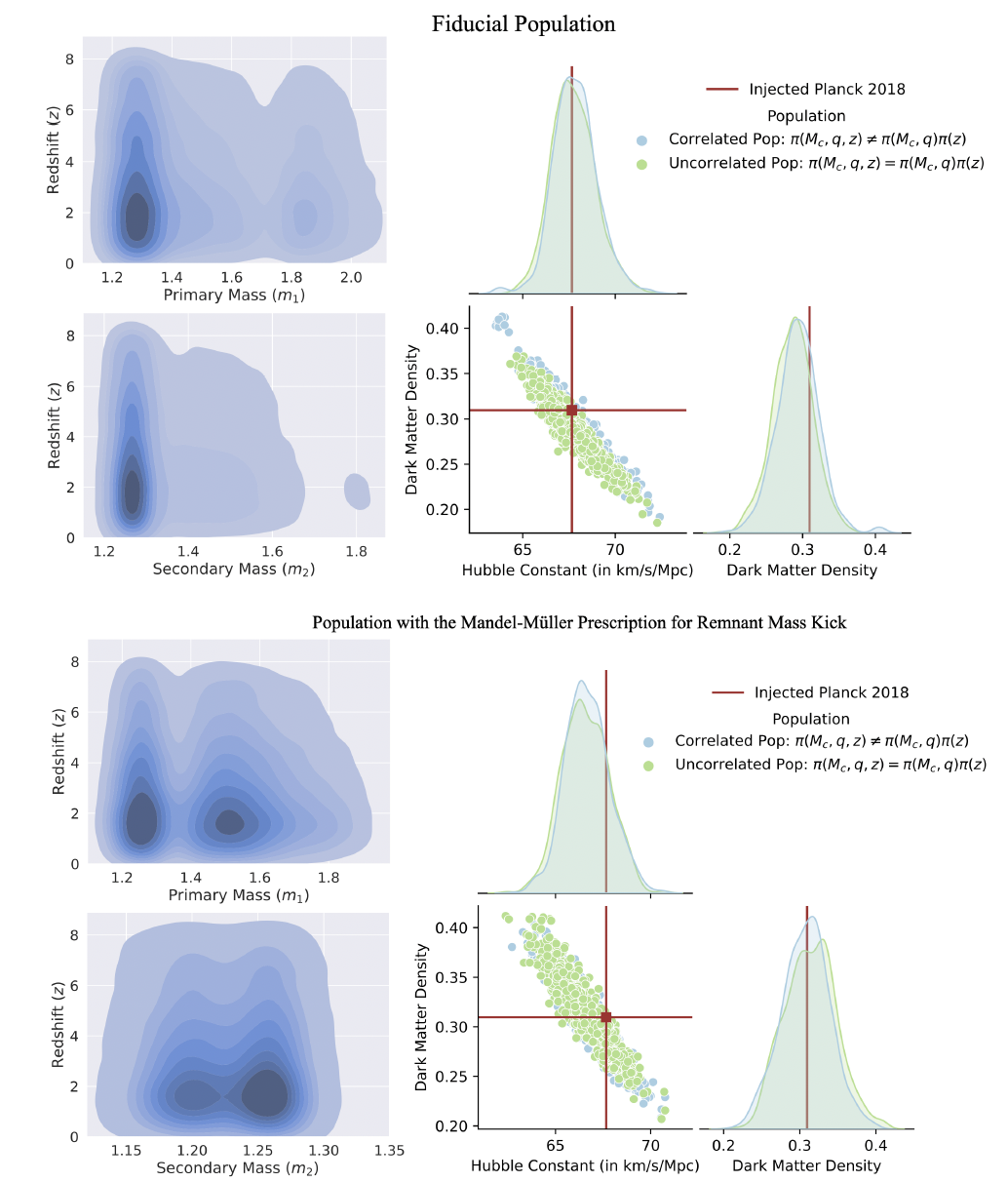
To make this method reliable, we must understand how the population of compact binary mergers changes across cosmic time. If mass and redshift are correlated, a model that ignores this correlation can bias our measurement of the expansion rate. One of my research themes is to identify and model such correlations so that we can use gravitational waves to robustly trace the expansion history of the Universe.

Cosmological measurements obtained using correlated and uncorrelated binary neutron star mass and redshift population models
Effect of correlations between the binary-neutron-star mass distribution and redshift evolution on measurements of the Hubble constant and matter density. From Roy, van Son, Ray, and Farr, Cosmology with Binary Neutron Stars: Does the Redshift Evolution of the Mass Function Matter?, The Astrophysical Journal Letters 985, L33 (2025) .

Earlier Research

During my undergraduate research, I worked on the theoretical foundations of gravitation and gravitational-wave cosmology. I studied how recursive self-coupling of linearized gravity reproduces the post-Minkowskian expansion of general relativity (Phys. Rev. D 102, 084045 (2020)) and investigated particle scattering in curved black-hole spacetimes (Phys. Rev. D 100, 064052 (2019)). I also explored how space-based gravitational-wave observatories such as LISA could constrain dark-energy models through standard-siren cosmography (MNRAS 500, 2896–2907 (2021)).